

If you’re a FERS employee dreaming of retiring early, you might be wondering: what are your actual options, and is early retirement even realistic for you? The good news is there are several paths available — but each comes with its own trade-offs around benefits, annuity reductions, and timing. Here’s a full breakdown of what’s on the table.
Special Category Employees and Law Enforcement Officers
If you fall into this category, you either know it or you don’t — and if you’re early in your career and this route appeals to you, you might consider if it’s worth looking into changing career paths to become a Special Category Employee (SCE).
Special category employees can retire with:
- 20 years of service at age 50, or
- 25 years of service at any age
Meet either requirement, and you can retire early with full benefits — keeping your FEHB (health benefits), FEGLI (life insurance), and immediate access to your TSP.
Early Retirement for Regular FERS Employees
For everyone else, here’s what’s available.
The Baseline: MRA + 30
Your Minimum Retirement Age (MRA) is 57 for most people still working today. If you hit MRA with 30 years of service, you can retire with full benefits — your FERS annuity, your Special Retirement Supplement (SRS), and continued access to FEHB, and FEGLI. You also have immediate access to TSP under the Rule of 55.
The Special Retirement Supplement (sometimes called the retirement annuity supplement, or informally the “Social Security supplement”) is a separate benefit from actual Social Security, even though the calculation is loosely based on it.
MRA + 10
If you hit MRA (57) but only have 10+ years of service — not the full 30 — you can still retire immediately, but with a catch: your annuity gets reduced by 5% for every year you’re under age 62.
For example, retiring at 57 under MRA + 10 means a roughly 25% permanent reduction to your first annuity (5 years under 62, at 5% each).
You do keep your benefits — FEHB, FEGLI, and TSP access all remain intact. But you will not receive the Special Retirement Supplement under this option.
One important note on MRA +10 is that you take a reduction of 5% for every year that you are under age 62 even if you have 20 years or more of service. There is a misconception by many people that the 5% reduction would only be for years under the age of 60 if you have 20 years or more.
Postponed Retirement
A postponed retirement also requires meeting MRA + 10 eligibility, but instead of collecting your annuity right away, you delay it — along with your benefits (FEHB, FEGLI) — until a later date.
For example: if you retire at 57 with 20 years of service, you could postpone collecting until age 60. Since retirement requirements are 20 years of service at age 60, waiting until 60 means no reduction in your annuity.
As with MRA + 10, you will not receive the Special Retirement Supplement under a postponed retirement.
Deferred Retirement
This option applies to anyone who leaves federal service early with 5 or more years of service, without withdrawing their retirement contributions.
Here’s how it works:
if you leave federal service at age 40 with 6 years in, you can contact OPM at age 62 and begin receiving a deferred retirement annuity — calculated based on those 6 years of service (roughly 6% of your high-3 average salary).
The drawback: under a deferred retirement, you receive no benefits — no FEHB, no FEGLI, and no SRS — just the annuity itself.
This is often the realistic path for people chasing the FIRE movement (Financial Independence, Retire Early) who want to leave federal service well before traditional retirement age, say around 45. If you leave at 45 with 20 years in, you could collect your annuity starting at 60; with less than 20 years, you’d wait until 62. Either way, no supplement and no benefits in the interim.
Voluntary Early Retirement Authority (VERA)
VERA has to be offered by your agency — it’s not something you can request on your own. It typically comes into play when an agency or department is trying to reduce its workforce.
Eligibility requirements:
- Age 50 with 20 years of service, or
- 25 years of service at any age
If you qualify and are accepted into a VERA offer, here’s what it looks like: say you retire at 50. You’ll receive your FERS annuity immediately, and you keep your FEHB and FEGLI intact. The one exception is TSP. Regular FERS employees need to retire in the year you turn 55 to get immediate TSP access, so retiring at 50 under VERA means no TSP access until age 591/2.
You also won’t receive the Special Retirement Supplement until you reach your MRA (57). So if you retire at 50 under VERA, you’ll receive your annuity and keep your benefits, but you’ll wait until 57 before the supplement kicks in.
Quick Summary
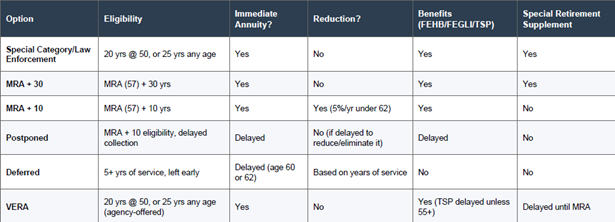
The Bottom Line
Early retirement is genuinely possible for federal employees — it just depends on your years of service, your age, and what your agency may be offering. Special category employees and law enforcement officers have the most straightforward path, while regular FERS employees have several routes (MRA + 10, postponed, deferred, or VERA) each with different trade-offs between collecting sooner versus keeping full benefits.
If you’re seriously considering early retirement, it’s worth sitting down and mapping out exactly what your specific timeline would look like. We partner with retirees to make their lives easier in retirement – you can schedule an introductory call if this is something you would like help with.